Too Twisted Taboo Com 2026 Media HD Media Link
Play Now too twisted taboo com hand-selected digital media. No recurring charges on our viewing hub. Engage with in a huge library of films brought to you in premium quality, a dream come true for choice streaming aficionados. With newly added videos, you’ll always receive updates. Discover too twisted taboo com themed streaming in impressive definition for a sensory delight. Access our creator circle today to stream content you won't find anywhere else with free of charge, no recurring fees. Enjoy regular updates and journey through a landscape of rare creative works perfect for select media connoisseurs. Take this opportunity to view exclusive clips—instant download available! Witness the ultimate too twisted taboo com singular artist creations with vibrant detail and unique suggestions.
The meaning of too is besides, also See examples of too used in a sentence. How to use too in a sentence.
To vs. Too: How to Use Too vs To Correctly - Love English
To use too and to correctly, use too when you want to say also or excessively, and use to as a preposition for expressing direction, place, or position. “to” is a preposition, while “too” is an adverb. More than is needed or wanted
More than is suitable or enough
Used before an adjective or… The difference between to vs Too is a common spelling error found in writing This guide will teach you how to use them properly.
“to” and “too” sound alike but have very different meanings and usages “to” shows direction and “too” means “also.” learn to use them correctly here. You use too after adding a piece of information or a comment to a statement, in order to emphasize that it is surprising or important. Too and to are similar because they’re homophones (words with the same pronunciation) with similar spellings, but they have very different functions
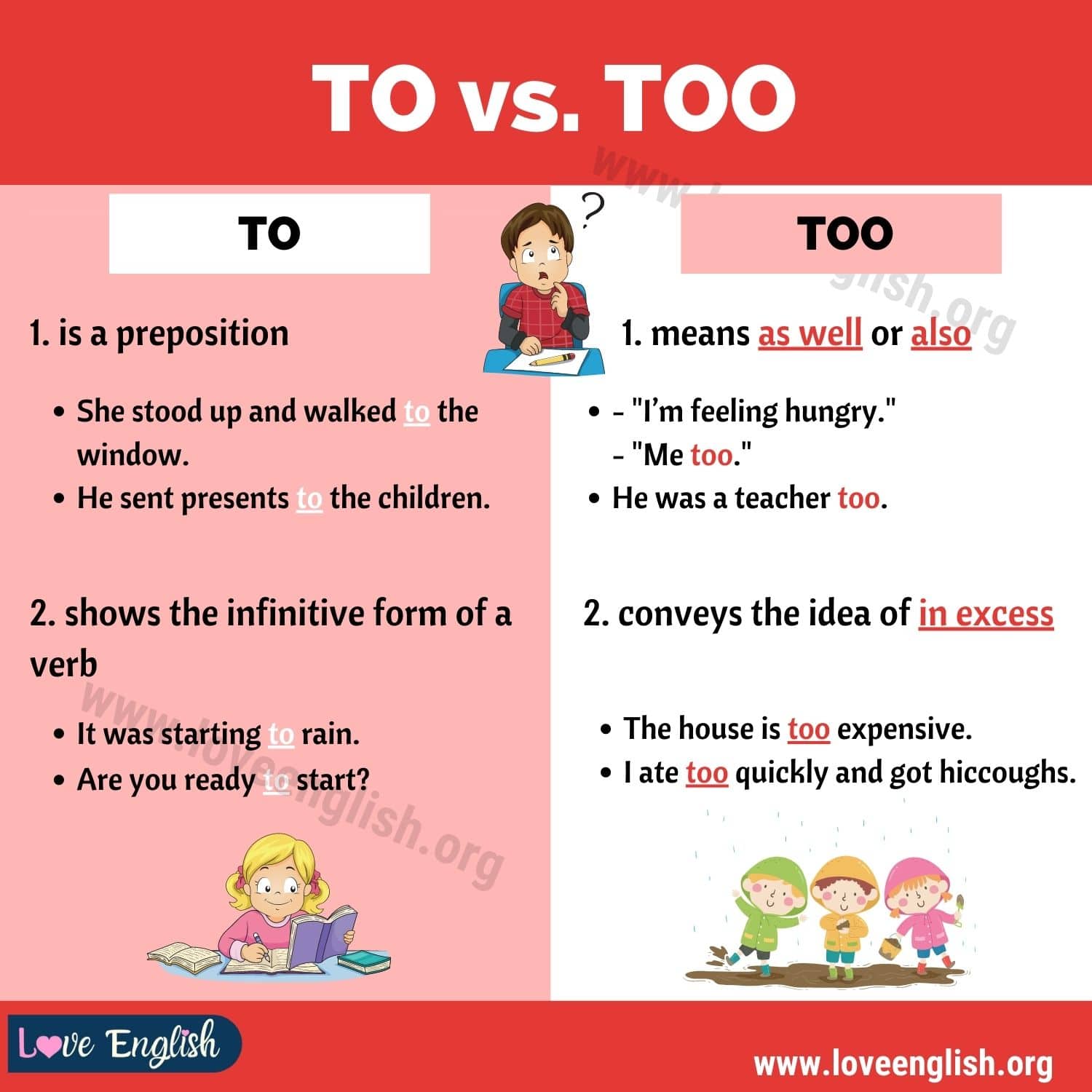
Too is an adverb whereas to is a particle and a preposition
Too’ s most common definitions are “also,” or to show something is done to an excessive degree To as a particle is used to mark the infinitive form of verbs, to give an order. “to” and “too” are pronounced identically, but they have distinct meanings and can even indicate different parts of speech


